
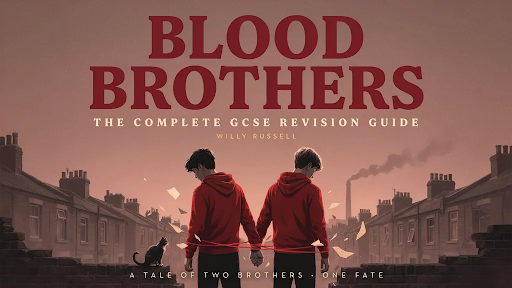
Everything you need for Blood Brothers revision in one place, who wrote it and why, when and where it’s set, full context on 1980s Liverpool and class divide, character and theme breakdowns in easy-reference tables, key quotes worth memorising, and practical exam tips for GCSE English Literature. We’ve also answered the exact questions students search for, so whether you need a quick fact check or a full revision session, it’s here.
Blood Brothers Revision: Where to Start
If you’re staring down a Blood Brothers exam question and don’t know where to begin, start with the basics: who wrote it, when, why, and what it’s actually about. Once those foundations are solid, the themes and characters make far more sense, and quotes become easier to remember because you understand why they matter.
Blood Brothers is a play, technically a musical by Willy Russell, following twin brothers Mickey and Edward, separated at birth and raised in very different social classes in Liverpool. It’s a fixture on the GCSE English Literature syllabus (commonly studied under AQA) precisely because it tackles class, fate, and family in a way that’s dramatic, emotional, and endlessly quotable for exam answers.
Who Wrote Blood Brothers?
Blood Brothers was written by Willy Russell, a Liverpool-born playwright also known for Educating Rita and Shirley Valentine. Russell left school at 15 with one O-Level and later trained as a hairdresser before returning to education as a mature student, a background that shaped his lifelong interest in class, opportunity, and the different paths people’s lives can take depending on where they start.
This detail matters for revision because it directly connects to the play’s central theme: Russell wasn’t writing about class divide as an outsider looking in, he lived it, which is part of why the play still feels so authentic decades later.
Why Did Willy Russell Write Blood Brothers?
This is one of the most-asked exam-style questions, and the answer ties directly into the play’s message. Russell has spoken about his fascination with the nature versus nurture debate, the question of whether a person’s character and fate are shaped by genetics or by upbringing and environment.
Blood Brothers answers that question through a dramatic device: identical twins, separated at birth, raised in opposite social classes. One (Edward) grows up wealthy and privileged; the other (Mickey) grows up working-class and financially insecure.
Because they share identical genetics, any differences in their outcomes must come from nurture, their environment, opportunities, and class, not nature. Russell used the play to argue that Britain’s class system, not individual merit or ability, was the real force shaping people’s futures.
The play originally began life as a much smaller school production before Russell developed it into the full-length musical audiences know today, first performed in Liverpool before transferring to the West End.
When Was Blood Brothers Written?
Willy Russell developed Blood Brothers in the early 1980s, with the full musical premiering in 1983 in Liverpool before later transferring to London’s West End in 1988, where it went on to become one of the longest-running musicals in British theatre history.
This timing is important context: Britain in the early 1980s was living through mass unemployment, industrial decline, and deep political division under Margaret Thatcher’s government, all of which fed directly into the play’s setting and themes.
Where Is Blood Brothers Set?
Blood Brothers is set in Liverpool, England. The city isn’t just a backdrop, it’s central to the story. Liverpool in this period was known for high unemployment following the decline of its docks and manufacturing industry, and the play uses this real economic backdrop to ground Mickey’s family’s poverty in a recognisable, historically accurate setting.
When Is Blood Brothers Set?
The play spans roughly the early 1960s to the early 1980s, following the twins from birth through to their deaths as young men. This twenty-year timespan lets Russell show how class and circumstance shape the brothers’ entire lives, not just a single moment. Mickey’s path grows increasingly difficult as unemployment rises through the 1970s and into the 1980s, while Edward’s private education and family wealth insulate him from the same struggles.
Blood Brothers Context: Class, Superstition and 1980s Britain
Understanding the historical and social context is often the difference between a good Blood Brothers essay and a great one. Key contextual points examiners look for:
- Class divide: Britain’s rigid class system in the 20th century, and how it dictated opportunities in education, employment, and social mobility
- Thatcherism and unemployment: Rising unemployment through the late 1970s and early 1980s, particularly in industrial cities like Liverpool, which hits Mickey’s family hardest
- Superstition: Mrs Lyons’ fear of “twins separated at birth” folklore, and the recurring motif of shoes on a table as a bad omen, used to build dramatic tension and foreshadow tragedy
- The Narrator: A device unique to the play’s structure, acting almost like a Greek chorus, reminding the audience of fate closing in on the brothers
- Genre blend: The play mixes comedy (especially in childhood scenes) with tragedy, creating an emotional contrast that makes the ending hit harder
For deeper background on the social history behind the play’s Liverpool setting, resources like National Museums Liverpool offer useful context on the city’s economic decline during this period, and BBC Bitesize’s Blood Brothers revision guide breaks down exam board-specific context if you’re studying under a particular syllabus.
Blood Brothers Characters: Revision Table
| Character | Role | Key Traits | Revision Focus |
| Mrs Johnstone | Mickey’s birth mother | Warm, superstitious, worn down by poverty | Represents working-class struggle and maternal sacrifice |
| Mrs Lyons | Edward’s adoptive mother | Controlling, anxious, guilt-ridden | Represents wealth, but also fear and isolation |
| Mickey Johnstone | Twin raised working-class | Funny as a child, increasingly desperate as an adult | Shows the damaging effects of unemployment and poverty |
| Edward Lyons | Twin raised wealthy | Privileged, well-educated, kind | Shows the advantages of class and opportunity |
| Linda | Mickey and Edward’s shared love interest | Loyal, practical, caught between both men | Highlights how class affects relationships and choices |
| The Narrator | Storyteller/chorus figure | Ominous, all-knowing | Builds tension and reinforces the theme of fate |
Blood Brothers Themes for Revision
| Theme | How It Appears in the Play | Exam Tip |
| Class and social division | Contrasting lives of Mickey and Edward despite identical genetics | Use specific scenes (e.g. the “guns” scene) to show how class shapes choices |
| Fate vs free will | The Narrator’s ominous warnings, the superstition motif | Discuss whether the characters’ outcomes feel inevitable or avoidable |
| Nature vs nurture | The twins’ shared genetics but opposite upbringings | Directly link to why Russell wrote the play |
| Motherhood and sacrifice | Mrs Johnstone’s hardship, Mrs Lyons’ guilt | Compare both mothers’ choices and consequences |
| Friendship and loyalty | Mickey and Edward’s bond despite class differences | Track how their friendship changes as the play progresses |
Blood Brothers Key Quotes to Remember
A few quotes come up repeatedly in exam questions and essays:
- “Now did you never hear it told that the Devil, Roman Catholic, and he was Jesus Christ, Protestant…” , the Narrator’s superstitious framing sets an ominous tone from the very beginning
- “Y’know our mam says that if either twin learns that he was one of a pair, they shall both immediately die” , establishes the central superstition driving the plot
- References to shoes on a table — a recurring symbol of bad luck that foreshadows tragedy each time it appears
When revising quotes, focus on understanding what device is being used (symbolism, foreshadowing, dramatic irony) rather than memorising word-for-word, examiners reward analysis over recitation.

Blood Brothers Revision Guide: Exam Tips
- Know your exam board’s focus. AQA and other boards may emphasise different aspects (character, theme, or context), check your specification before revising blindly
- Use the PEA/PEEL structure (Point, Evidence, Analysis, Link) to keep essay answers focused
- Always connect back to context. Class and 1980s Britain aren’t just background detail, examiners specifically reward context woven into analysis, not bolted on
- Track structure, not just plot. The Narrator’s role, the use of song, and the cyclical structure (the play opens with the twins’ deaths, then rewinds) are all worth analysing separately from character and theme
What Willy Russell’s Story Teaches Aspiring Writers
Willy Russell’s own journey, a school leaver with one O-Level who became one of Britain’s most studied playwrights, is a genuinely useful case study, whether you’re writing a school project, a play, or your first book. A few takeaways:
- Write what you know. Russell’s working-class Liverpool upbringing gave Blood Brothers its authenticity — readers and audiences respond to lived experience
- A small idea can grow. The play began as a modest school production before Russell expanded it into a full musical — first drafts rarely arrive fully formed
- Structure carries emotional weight. The Narrator device and cyclical structure aren’t decoration — they’re doing real storytelling work, which is worth studying if you’re developing your own manuscript
If you’re working on your own script, novel, or story inspired by real experience, shaping that raw idea into a structured manuscript is exactly what our book writing services are built for, turning a strong concept into a properly paced, publishable piece of work.
How Book Publishers Online Can Help You Go From Idea to Published Book
Whether you’re a student inspired to write your own stories after studying Blood Brothers, or simply have a manuscript sitting unfinished, getting from a rough idea to a finished, published book takes more than good writing alone. That’s where we come in:
- Writing support to structure your story properly from the start, see our book writing services
- Professional editing to sharpen dialogue, pacing, and structure, much like the tight structural choices that make Blood Brothers so effective, via our book editing services.
- Ebook publishing if you want a fast, affordable route to readers, through our ebook publishing services
- Marketing support to build an audience once your book is ready, via our book marketing services
If studying classic and modern stories has you hooked on reading more, our guides to the Shatter Me series reading order and Skulduggery Pleasant’s impact on UK children’s fantasy are worth a look next.
Frequently Asked Questions
Who wrote Blood Brothers?
Blood Brothers was written by Willy Russell, a Liverpool-born playwright also known for Educating Rita and Shirley Valentine.
Why did Willy Russell write Blood Brothers?
Russell wrote the play to explore the nature versus nurture debate and to critique Britain’s class system, using twin brothers separated at birth and raised in different social classes to show how environment, not genetics, shapes a person’s fate.
When was Blood Brothers written?
The musical was developed in the early 1980s and first performed in Liverpool in 1983, later transferring to London’s West End in 1988.
Where is Blood Brothers set?
The play is set in Liverpool, England, using the city’s real economic decline and unemployment during this period as central context.
When is Blood Brothers set?
The story spans roughly the early 1960s to the early 1980s, following the twins from birth to their deaths as young adults.
What is Blood Brothers context important for exams?
Key context includes 1980s Britain’s class divide, rising unemployment under Thatcherism, superstition (particularly around twins and bad omens), and the play’s blend of comedy and tragedy.
What are the main themes in Blood Brothers?
The core themes are class and social division, fate versus free will, nature versus nurture, motherhood and sacrifice, and friendship across class lines.
What type of text is Blood Brothers — a play or a musical?
It’s both. Blood Brothers is a play with music, often classified as a musical due to its songs, but it’s studied as a play text for GCSE English Literature.
Why Blood Brothers Still Resonates Decades Later
What keeps Blood Brothers on syllabuses and in theatres more than forty years after it was written isn’t nostalgia, it’s that the questions it asks haven’t gone away. Class, opportunity, and how much of our lives come down to where we start rather than who we are still shape real conversations in Britain today, which is exactly why the play keeps finding new readers and new audiences.
That staying power also says something about storytelling itself: a simple, honest premise, told well, can outlast trends entirely. If Willy Russell’s journey from a school leaver with one O-Level to one of Britain’s most studied playwrights proves anything, it’s that a story worth telling doesn’t need a perfect starting point, just the right structure and the persistence to see it through.
Whether after studying Blood Brothers, you are inspired to write your own book or you just have an unfinished manuscript lying around, Book Publishers Online can help you shape up your manuscript to completion. Contact us for any useful insight from our publishing team and consultancy on your future steps as an author.