
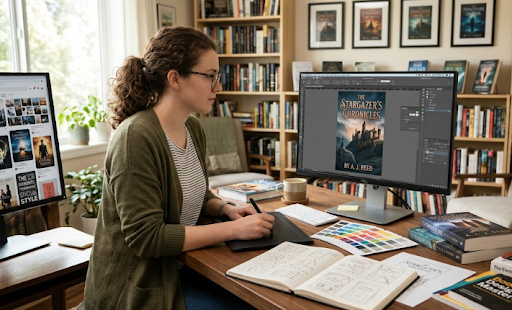
Choosing the right approach to book cover design UK authors can trust is one of the most important decisions you will make before publishing. A cover is not decoration. It is the first handshake between your book and a reader, and in a crowded market of self-published and traditionally published titles alike, that handshake needs to be firm, confident, and unmistakably right for your genre.
Whether you are weighing up book cover design ideas for a debut novel, exploring how to design a book cover for a children’s picture book, or comparing book cover design services before you commit a budget, this guide walks through everything you need to know.
At Book Publishers Online, we work with authors across the UK who are publishing everything from literary fiction to academic non-fiction, and the cover question comes up in almost every conversation.
Get it right, and your book competes credibly on the shelf or in a Kindle thumbnail grid. Get it wrong, and even brilliant writing struggles to find readers. This article breaks down the practical, strategic, and creative sides of cover design so you can make an informed choice.
Why Book Cover Design Matters More Than Authors Expect
Readers judge books by their covers, whatever the old saying claims. Data from retailers and self-publishing platforms consistently shows that cover imagery is one of the top three factors influencing a purchase decision, often ranking above the blurb itself.
A strong cover does several jobs simultaneously: it signals genre at a glance, it communicates tone and quality, and it creates enough curiosity to make a browser stop scrolling. This is particularly true for digital retail. On Amazon and other platforms, a cover is frequently viewed first as a small thumbnail on a phone screen.
A Kindle book cover design service needs to account for this from the outset, designing typography and imagery that remains legible and striking even at a fraction of its printed size. A cover that looks stunning as a large print proof but collapses into illegible clutter as a 300-pixel thumbnail is not doing its job.
Design Your Own Book Cover vs Hiring a Professional
Many authors, particularly those working with tight budgets, ask whether they should design their own book cover or bring in outside help. Both paths are valid, but they suit different circumstances.
When DIY Makes Sense
If you have some design experience, access to tools such as Canva or Adobe Express, and a genre where a simple book cover design is genuinely appropriate (some poetry collections, personal memoirs for private circulation, or short-run family history projects), doing it yourself can work.
The key risks are typography that looks amateurish, stock imagery that has been overused across thousands of other covers, and a layout that does not translate well between formats such as paperback, hardback, and ebook.
When a Professional Service Pays For Itself
For anything intended for wide commercial release, particularly fiction, business books, or children’s titles, professional book cover design services almost always deliver a better return than the time and risk saved by doing it in-house.
A book cover designer UK authors hire through an established studio brings genre knowledge, an understanding of current market trends, and technical skill with print-ready file preparation that most authors simply do not have time to develop themselves.
If you are unsure which route suits your project, speak to our design team about your genre, budget, and timeline, and we will give you an honest recommendation, even if that means pointing you towards DIY tools for a smaller project.

How to Design a Book Cover: The Core Process
Understanding how to design book cover projects, whether you outsource the work or attempt it yourself, helps you brief designers more effectively and evaluate drafts with a critical eye. The process generally follows these stages.
1. Genre and Market Research
Before any visual work begins, a strong designer studies bestsellers in your specific subgenre. A cosy crime novel needs a different visual language to a psychological thriller, even though both sit under “crime fiction”. This research stage prevents covers that look generically “book-like” rather than genre-accurate.
2. Concept Development
Two or three distinct concepts are usually sketched or mocked up at this stage, exploring different typographic treatments, colour palettes, and imagery directions. This is where creative book cover design earns its name, balancing originality against the visual conventions readers expect from your category.
3. Typography and Hierarchy
The title, author name, and any supporting text (series branding, endorsement quotes, and subtitle) need a clear visual hierarchy. This is often where book front cover design succeeds or fails. Overcrowded covers with too many competing text elements read as unprofessional, regardless of how good the illustration or photography underneath is.
4. Back Cover and Spine
Book back cover design is frequently an afterthought for first-time authors, yet it carries the blurb, author bio, barcode, and pricing, all of which need to work as a cohesive unit with the spine and front cover. For print runs, spine width must be calculated precisely against final page count, something a professional print-ready workflow accounts for automatically.
5. File Preparation and Proofing
The final stage involves preparing print-ready PDFs with correct bleed, colour profiles (CMYK for print, RGB for digital), and resolution, alongside optimised JPEG or PNG files sized correctly for Amazon KDP, IngramSpark, and other distribution platforms.
Book Cover Design Ideas by Genre
Different categories call for different visual strategies. A few starting points worth considering:
- Literary fiction often favours abstract or symbolic imagery, muted colour palettes, and understated typography that signals seriousness and craft.
- Commercial thrillers and crime lean towards high-contrast colour, bold sans-serif typography, and imagery suggesting tension, such as silhouettes, shadows, or fractured scenes.
- Romance typically uses warmer palettes, script or elegant serif typefaces, and imagery centred on characters or intimate settings.
- Children’s book cover design requires bright, friendly illustration, rounded and highly legible typefaces, and character-forward compositions that appeal directly to a young reader browsing with a parent or teacher.
- Non-fiction and business titles generally favour clean, confident typography with minimal imagery, prioritising credibility over decoration.
- Art book cover design often inverts typical conventions entirely, using the interior artwork itself, generous white space, and premium finishing touches such as embossing or spot varnish to signal a high-value object.
For English book cover design aimed specifically at the UK and wider English-language market, it is worth noting that reader expectations differ subtly from US conventions, particularly around typography restraint and colour saturation. A designer familiar with UK retail norms will account for this automatically.
Want tailored book cover design ideas for your specific manuscript? Request a free concept sketch from our team and see three genre-accurate directions before committing to a full design brief.

How Much Does It Cost to Design a Book Cover?
This is one of the most common questions we receive, and the honest answer is that it depends heavily on scope. Broadly, UK authors can expect the following bands:
- Templated or semi-custom covers: the most affordable option, using pre-built layouts adapted with your title, author name, and a licensed stock image.
- Fully custom covers with stock imagery: a mid-range option involving original concept development, bespoke typography, and licensed photography or illustration.
- Fully bespoke illustrated or photographed covers: the premium tier, involving commissioned illustration or original photography and extensive concept exploration, and full print packaging (front, back, spine, and often dust jacket for hardback editions).
Ebook covers are generally less expensive than covers requiring full print packaging, since there is no spine calculation, bleed, or back cover copy layout involved.
If budget is a primary concern, ask any book cover design agency for a clear breakdown of what each pricing tier includes before you commit, since “custom” can mean very different things between studios.
Choosing a Book Cover Design Agency
Not all studios are equal, and the difference between an average result and the best book cover design for your project often comes down to a handful of practical factors.
Portfolio Relevance
Look for a book cover designer whose portfolio includes work in your specific genre, not just attractive design generally. A designer skilled at minimalist business book covers will not necessarily produce a convincing fantasy or romance cover.
Process Transparency
A trustworthy agency will explain how many concepts you receive, how many rounds of revision are included, and what the full deliverable package looks like (print files, e-book files, source files, and social media assets).
Turnaround and Communication
UK authors working towards a specific publication date need clear, realistic timelines. Ask about typical turnaround for concept delivery and final file handover before you sign anything.
Understanding of Distribution Requirements
A strong book cover design agency understands the technical specifications required by Amazon KDP, IngramSpark, and UK print distributors and will not hand you files that get rejected at the upload stage.
If you already have a KDP login and are preparing to self-publish, ask your designer directly whether they will supply KDP-compliant cover files as standard, since dimension and resolution requirements are strict and unforgiving.

Book Cover Design and Your Wider Publishing Journey
A great cover rarely exists in isolation. It works best as part of a coordinated publishing strategy that includes professional editing, formatted interiors, and a clear distribution plan.
If you are exploring ebook publishing services or comparing the best book publishing services in the UK, it is worth choosing partners who can support the full journey rather than a single isolated deliverable. A cover designed without reference to your interior formatting or your chosen distribution platform can create avoidable friction later in the process.
At Book Publishers Online, cover design sits alongside editing, formatting, and distribution support, so your book moves from manuscript to market as a coherent, professionally finished product rather than a series of disconnected purchases.
Frequently Asked Questions
How much does it cost to design a book cover in the UK?
Costs vary significantly depending on scope and studio. Templated or semi-custom covers sit at the affordable end, while fully bespoke illustrated covers with commissioned artwork sit at the premium end. Ebook-only covers tend to cost less than covers requiring full print packaging since there is no spine width calculation, bleed allowance, or back cover layout to manage.
Can I design my own book cover without professional help?
Yes, it is possible, particularly for lower-stakes projects such as personal memoirs, small poetry collections, or family history books with a limited private readership. Free and low-cost tools make basic layout achievable for authors with some design sensibility..
What makes a good children’s book cover design?
A strong children’s cover uses bright, inviting colour, character-forward illustration, and highly legible, friendly typography suited to being read by both children and the parents or teachers selecting the book on their behalf.
Do I need different cover files for print and Kindle publishing?
Yes. Print covers require a single wraparound file covering the front, spine, and back, with the correct bleed, trim size, and CMYK colour profile matched to your specific page count and paper stock, since spine width changes with page count. Kindle and other ebook formats need only a front-facing cover, sized and formatted according to each platform’s specific resolution and file format requirements, typically in RGB colour.
Final Thoughts on Book Cover Design UK
Getting book cover design UK support right, whether through a DIY approach, a freelance designer, or a full-service agency, comes down to matching the level of investment to the ambitions you hold for your book.
A quiet personal project can often succeed with a simple, well-executed DIY cover. A book intended for wide commercial release deserves the genre research, typographic care, and technical precision that a professional book cover design agency brings as standard.
Whichever path you choose, treat your cover as a serious marketing asset rather than a final formality, because it is very often the single image that decides whether a reader picks your book up at all.
Ready to see what a professional cover could do for your book? Get a free, no-obligation quote from Book Publishers Online by contacting us today and take the guesswork out of your cover design decision.