
If you ask ten writers how much is the cost of book publishing in UK, you will get ten different answers. One will tell you nothing, while another one will tell you that it costs £8,000. Both are correct, because publishing can mean very different things.
For a self-published book produced to professional standards, the reasonable cost is £1,500 to £5,000. Some British guides put a full editing and marketing package as high as £7,100. This guide explains the cost structure, how to cut costs safely, and where skimping costs you sales.
The short answer: what most UK authors spend
The following table shows the estimated price ranges published by UK-based sources in 2026. Consider these as estimates, not quotations. An estimate of 120,000 words for a fantasy novel will differ from an estimate of 40,000 words for a business book.
| Cost item | Typical UK range |
| Developmental editing | £800 to £2,500 |
| Copyediting and proofreading | £400 to £1,200 |
| Cover design (professional) | £250 to £800 |
| Formatting (print and ebook) | £150 to £500 |
| ISBN (Nielsen) | £93 single, £174 for ten |
That puts you in the £1,500-£5,000 range. One UK source reports that authors have been successful with figures between £1,500 and £2,500, so the amount doesn’t have to be high but should be carefully considered.
Self-publishing costs, line by line
Editing
This is when new writers usually under-budget, and where the readers can tell most. Editors typically charge per hour, word, or project. The Chartered Institute of Editing and Proofreading provides minimum recommended hourly rates (£31.92 for proofreading, £37.11 for copyediting, and £42.66 for developmental editing – for 2026). The CIEP updates these rates each March, so make sure you see the latest table. These are base rates. Many experienced editors charge more than this.
This is the step that many guides skip. You don’t always have to get every type of edit. An author writing a first novel with structural issues must get a developmental edit first. The well-written and revised book may only need copyediting and proofreading. Get a sample edit done on a few pages first. Any good editor will do it for you.
Find out more at our Book editing services page.
Cover design
People do judge a book by its cover, and they do it within a second on a crowded retail page. Professional designers from the UK usually charge around £250- £800, while custom illustrations can cost more than £1,500. Templates cost less, but they look like templates.
If the budget is tight, invest in the cover before marketing. Every penny will be working much harder if the cover is done well. Visit our book cover design service to see our examples.
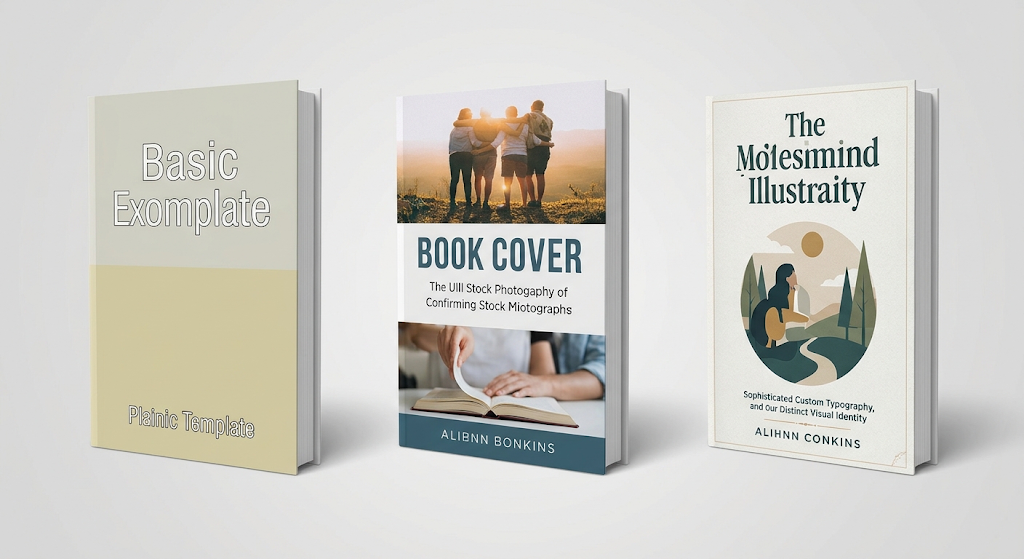
Alt text: Three paperback mockups showing the difference between template and custom book cover design.
Formatting and layout
The cost of interior formatting is between £150 and £500, depending on how complex the design is. The cost of formatting a novel in plain text will be low, but for non-fiction books with tables, figures, and footnotes, the cost of book publishing in uk will be high. Formatting mistakes are evident when there are problems such as irregular margins, improper start of chapters, and inconsistent fonts. Retailers may reject such files due to not meeting their standards. A professional formatting service can help you to remove that risk.
ISBNs
In the UK, ISBN numbers are available through Nielsen. At the time of writing, Nielsen’s ISBN store prices each ISBN at £93 and £174 for ten ISBNs at a discount, VAT included. Prices vary, so check on the day of purchase.
Each format requires its own unique number. So there would be a separate ISBN for paperback, hardcover, and ebook formats, making the ten-pack of ISBNs more economical for most authors. While Amazon offers a free ISBN, this is a legitimate choice, but Amazon will be shown as the publisher on your book, something most UK bookstores prefer to avoid.
Printing and distribution
The biggest advantage of printing on demand is that you do not have to store any boxes of unsold copies. The only time you pay the unit cost is when the book is sold, and its price varies according to the number of pages, paper quality, and whether it is in colour or black and white. Offset-print books can be used by some non-fiction authors who sell their books through personal appearances, though they require upfront investment.
One UK detail worth knowing: print books are zero-rated for VAT, but ebooks are subject to 20% VAT. Price your ebook with that in mind.
Marketing
This is the uncapped line. It can start at £0 if you develop your audience gradually, or thousands of pounds if you choose advertising and PR. We won’t pretend there’s a universal figure here (authors spend an average of $636 a month on marketing). However, a good starting point can be a conservative budget that you track, and then grow from there. Our book marketing services can help you decide where the first £500 will do the most good.
Traditional publishing: no bill, different price
A traditional publisher covers editing, formatting, printing, and distribution. The writer gets an advance and royalties. In theory, this way seems to be the cheapest one.
The true expenses lie elsewhere. Securing an agent and making a deal may take more than a year, and most proposals are unsuccessful. Having signed a contract, the author usually gives up control over the cover, title, cost, and schedule. Royalty rates are less per copy than in self-publishing. And the promotional budget for a newcomer is often smaller than most writers believe.
It is not about which option is cheaper. The choice is between spending money and control. Our comparison of self-publishing and traditional publishing sheds light on the matter.
Hybrid and assisted publishing: ask harder questions
Hybrid publishers charge the author for production costs and then split royalty rates. They come in all varieties. Some of them are very good, while others are expensive self-publishers with fancy brochures.
Before you sign any contract, request an itemised bill and find out who will own the ISBN and copyrights, and how you will get out of the contract. The Society of Authors provides contract checking for its members. If the company can’t give these simple answers, don’t even think about it.
A worked example
Here is a sample budget for a 70,000-word nonfiction book, based on midrange numbers from the table above.
Copyedit: £700.
Proofreading: £400.
Professional cover: £400.
Formatting: £150.
ISBN: £93.
Total: £1,743, excluding marketing.
Throw in a £500 marketing budget, and that brings the total to about £2,250.
If the manuscript requires a development edit as well, then add £800 to £2,500. That is why the first step in being honest should be a manuscript assessment.
Where authors waste money
- Avoiding editing and then paying for a second round of fixes after mistakes are found through the review process.
- Paying for the premium package that you do not need.
- Purchasing the costly cover before having any concept of the visual standards of the genre.
- Advertising before the page, blurb and sample are ready to sell.
These issues have nothing to do with overspending or underspending. They are about spending in the wrong order.
Conclusion: Plan your budget with a publishing team
The cost of book publishing in UK is affordable if you have an idea of what each dollar spent will purchase. You first have to establish the manuscript’s actual requirements and price each service separately. We at Book Publishers Online offer clear, itemised quotes for all our services to make your life easier.
If you are considering your options, you can take a look at our self-publishing services or get a customised quote for your manuscript.
FAQs
How much does it cost to publish a book in the UK?
For a professionally published self-book, the typical budget ranges from £1,500 to £5,000. For a more extensive package, it could cost approximately £7,100. A minimal package could cost less than £1,000, but the bulk of the work would need to be done by you.
Is self-publishing cheaper than traditional publishing in the UK?
To begin with, traditional publishing is cheaper because the publisher covers the production costs. Self-publishing is expensive initially, but the author has control and earns more from sales.
Do I need to buy an ISBN in the UK?
Not necessarily for all platforms. For example, Amazon provides an ISBN for free, but it lists Amazon as the publisher. In case you wish to distribute through bookstores and libraries, you have to purchase one from Nielsen.
How much should I spend on editing?
It depends on the word count and the state of the manuscript. Developmental editing in the UK usually costs between £800 and £2,500, and the combined cost of copyediting and proofreading is between £400 and £1,200.
Can I publish a book in the UK for free?
A file may be uploaded on platforms such as Amazon KDP without paying any fee. However, taking a free course normally means no editing, no customised cover, and a lack of marketing strategies.