
Table of Contents
- David Johnson
- No Comments
Every book on a shelf, whether in a Waterstones window or a Kindle library, went through a process most readers never think about. Aspiring writers often ask the same question: how does book publishing actually work?
The honest answer is that there is no single path. A manuscript can travel through a traditional publishing house with an agent, or it can be released by the author through self book publishing uk. Choosing a trusted book publishing partner is essential to navigate these routes, ensuring your book publication uk journey is successful.
This guide breaks down how book publishing uk works, covering professional book publishing services, timelines, and the practical steps you can take today to publish a book online in the UK.
What Is Publishing?
Publishing is the process of turning a written manuscript into a finished product, such as a printed book, an ebook or an audiobook, and making it available for readers to buy. In simple terms, book publishing involves editing, designing, producing, distributing and marketing a piece of writing so it can reach an audience.
A publisher can be a large company with in-house editorial, design and sales teams, a small independent press, or the author acting as their own publisher through self-publishing. What separates publishing from simply writing is distribution.
A manuscript becomes a published book only once it has been formatted, registered with an ISBN, and made available for sale or loan through at least one retail or library channel.
The Two Main Routes Into Print: Traditional Publishing vs Self-Publishing
Almost every question about how to get a book published UK authors ask comes down to a choice between two models. Traditional publishing puts a publishing house in charge of costs, production and distribution in exchange for a share of the profits. Self-publishing puts the author in charge of every decision and every cost, in exchange for keeping the majority of the royalties. The table below sets out how the two compare.
| Factor | Traditional Publishing | Self-Publishing |
|---|---|---|
| Who pays upfront costs | The publisher | The author |
| Editorial control | Shared with a commissioning editor | Author retains full control |
| Typical royalties | 7% to 25% of net or list price | 35% to 70% depending on platform |
| Speed to publication | 12 to 24 months on average | A few weeks to several months |
| Distribution reach | Bookshops, wholesalers, international rights deals | Online retailers, print-on-demand, direct sales |
| Advance payment | Often, though not guaranteed | Not applicable |
How Traditional Book Publishing Works, Step by Step
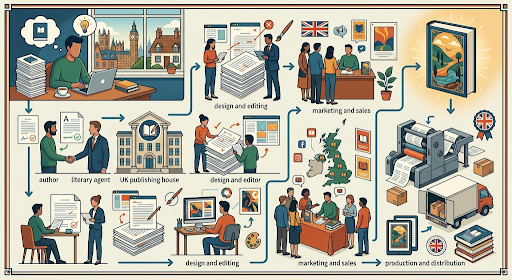
Traditional book publishing follows a fairly consistent sequence, even though timelines vary between publishers. Here is how a manuscript becomes a published book through this route.
1. Finding a Literary Agent
Most major UK publishers accept submissions only through literary agents, so this is usually the first hurdle. Agents read large numbers of manuscripts and take on the ones they believe they can sell. Authors researching how to find a book publisher in the UK often discover that approaching the right agent is the real first step.
2. Submission and Publisher Offers
Once signed, an agent submits the manuscript to commissioning editors. If more than one editor wants the book, the author and agent may choose the best fit, or the publishers may enter an auction, with the highest bidder winning the rights.
3. Contract Negotiation and Advance
The agent negotiates royalty rates, rights and, often, an advance against future royalties. This is the point at which the book officially moves from manuscript to acquired title.
4. Editing the Manuscript
Editing typically takes many months and can include structural changes, line edits and a full copyedit and proofread. Editors may suggest cutting characters, reworking the ending, or tightening pacing.
A thorough book editing service mirrors this exact process for authors who are publishing independently, which is why editing is one of the few stages that both routes share almost identically.
5. Book Production
The production team manages typesetting, print specifications and the overall schedule that every other department has to work around. This stage turns an edited manuscript into pages that are ready to be printed or converted into an ebook file.
6. Cover Design
A cover must communicate genre and tone at a glance. A skilled Book Cover Designer studies comparable titles to give your work the best shelf presence. This visual identity is a core part of what book publishers uk provide.
7. Sales and Distribution
The sales team pitches the book to retailers, from supermarkets and independent bookshops to online stores, and makes sure stock levels match expected demand. International sales teams handle the same process in overseas markets.
8. Rights Sales: Translations, Film and TV
If the publisher controls translation or adaptation rights, the rights team sells those rights to foreign publishers and to film or television production companies. This can become a significant additional income stream for both the publisher and the author.
9. Marketing and Publicity
Marketers handle advertising and paid promotion. A dedicated Book Marketing service plays this role for authors who do not have an in-house team. Additionally, Wikipedia Page Creation can help establish a notable author presence online, a service offered by the best book publishers online.
10. Publication Day
After months, or often years, of work, the book finally becomes available to buy. For most traditionally published titles, this single day is the visible tip of a very long process.
How Self-Publishing Works, Step by Step
Self-publishing follows a similar sequence of stages, but the author makes every decision and either does the work themselves or hires professionals directly. This is how most authors answer the question of how to publish a book without going through a literary agent.
1. Writing and Revising Your Manuscript
Every publishing route starts with a finished, revised manuscript. Authors who follow a structured process for how to write a book step by step tend to finish faster and need fewer rounds of rewriting later on.
2. Editing and Proofreading
Skipping professional editing is the single most common reason self-published books get poor reviews. A structural edit, a line edit and a final proofread catch problems that an author is simply too close to the text to see, which is why most authors bring in a book editing service rather than relying only on their own read-through.
3. Formatting for Print and Ebook
A manuscript needs different formatting for a paperback interior, an EPUB ebook file and, increasingly, an audiobook script. Getting this wrong is one of the fastest ways to lose readers on platforms like Kindle, so many authors turn to a dedicated ebook publishing service to handle the technical side correctly the first time.
4. Designing a Cover That Sells
Self-published covers are judged against traditionally published covers on the same retail page, so there is no room for an amateur look. A professional book cover designer gives an independently published book the same shelf presence as one from a major imprint.
5. Getting an ISBN and Registering Your Book
In the UK, ISBNs are issued by Nielsen, the UK ISBN agency. Each format of a book, paperback, hardback and ebook, needs its own ISBN. UK publishers also have a legal obligation to send a copy of each published title to the British Library under legal deposit, so this stage is about more than just discoverability, it is a legal requirement too.
6. Choosing Where to Publish: KDP and Other Platforms
Amazon Kindle Direct Publishing is the most widely used platform for UK self-publishers, though IngramSpark and other services extend reach into bookshops and libraries. Authors following a guide on how to publish a book on Amazon KDP usually publish their ebook and paperback within days of finishing formatting, and once an account is set up, returning to complete a KDP login UK takes seconds for each new release.
7. Printing Paperbacks and Hardbacks
Print-on-demand makes physical books accessible to all. Using professional Book Printing Services ensures high-quality binding and stock, which is why authors often choose an experienced self-book publisher for their physical editions.
8. Marketing Your Self-Published Book
Without a publisher’s marketing department, promotion falls entirely on the author. This covers everything from retail keyword optimisation to social media, email lists and review outreach, which is exactly the gap a dedicated marketing partner is built to fill.
Hybrid Publishing: A Middle Path Worth Understanding
Hybrid publishing sits between the two main routes. The author contributes towards production costs, but a publishing team handles editing, design, distribution and often marketing, and the author typically keeps a higher royalty share than a traditional deal would offer.
Genuine hybrid publishers are selective about which manuscripts they take on and are transparent about costs and services provided. This is different from a vanity press, which accepts almost any manuscript in exchange for payment and delivers little in the way of editorial quality, distribution or marketing support.
How to Get a Book Published in the UK: A Practical Checklist
Regardless of which route you choose, the following checklist covers the practical actions that move a manuscript towards publication.
- Finish and revise your manuscript until it reads as a complete, polished piece of work.
- Decide between traditional publishing, self-publishing or a hybrid model based on your budget, timeline and goals for creative control.
- Research literary agents if pursuing traditional publishing, or research platforms and service providers if self-publishing.
- Invest in professional editing, since this step affects reader reviews more than almost any other decision.
- Commission a cover design that matches reader expectations for your genre.
- Register an ISBN and prepare accurate metadata for retailers and libraries.
- Set a realistic publication date and build a marketing plan around it, rather than treating marketing as an afterthought.
Authors weighing up independence against the reassurance of expert support often find that reading a full self-publishing guide for British authors makes the decision considerably easier, since it lays out exactly what each stage of independent publishing actually involves.
How Long Does It Take to Publish a Book?
Timelines vary by publisher and by author, but the table below gives a realistic range for each stage.
| Stage | Traditional Publishing | Self-Publishing |
|---|---|---|
| Finding representation or a platform | 3 to 12 months | A few days |
| Editing | 6 to 18 months | 4 to 10 weeks |
| Design and production | 2 to 4 months | 2 to 6 weeks |
| Pre-launch marketing | 3 to 6 months | 2 to 8 weeks |
| Total time to publication | 12 to 24 months | 8 weeks to 6 months |
How Much Does It Cost to Publish a Book in the UK?
Traditional publishing carries no upfront cost to the author in most cases, since the publisher funds production. Self-publishing costs vary widely depending on how much is outsourced.
| Cost Item | Traditional Publishing | Self-Publishing (typical range) |
|---|---|---|
| Editing | Covered by publisher | £500 to £3,000 |
| Cover design | Covered by publisher | £150 to £800 |
| Formatting (print and ebook) | Covered by publisher | £100 to £500 |
| ISBN registration | Covered by publisher | £89 for a single ISBN, less per unit in blocks |
| Marketing | Partially covered by publisher | £200 to £2,000 or more |
Book Production Explained: From Manuscript to Finished Book
Book production covers everything that turns an edited manuscript into a physical or digital object a reader can buy. This includes typesetting the interior pages, generating print-ready PDF files, converting the manuscript into EPUB and MOBI formats for ebook retailers, and, where relevant, producing an audiobook.
Print runs can use offset printing for large quantities at a lower per-unit cost, or print-on-demand for smaller, flexible quantities with no warehousing required. A combined ebook publishing service and book printing service allow an author to release paperback, hardback and digital editions from a single production process rather than managing each format separately.
Who’s Who in Publishing: Key Industry Roles Explained
| Role | What They Do |
|---|---|
| Literary agent | Represents authors and sells manuscripts to publishers on their behalf |
| Commissioning editor | Acquires manuscripts and oversees a book from acquisition to publication |
| Copy editor | Corrects grammar, consistency and clarity at the sentence level |
| Production editor | Manages typesetting, print specifications and publishing schedules |
| Cover designer | Creates the visual identity that represents the book to readers |
| Marketing manager | Plans advertising, promotions and retail visibility campaigns |
| Publicist | Secures media coverage, reviews and author events |
| Rights manager | Sells translation, film and TV adaptation rights |
Common Mistakes Authors Make When Publishing a Book
- Skipping professional editing to save money, which usually costs far more in lost reviews and sales later.
- Choosing a cover design that does not match reader expectations for the genre.
- Publishing without an ISBN, which limits listing in bookshops, libraries and bibliographic databases.
- Setting an unrealistic timeline and rushing production stages that need proper attention.
- Ignoring retail metadata and keywords, making the book harder for readers to discover.
- Treating marketing as something to think about after publication day instead of before it.
- Signing with a publisher or service provider without checking contract terms and reputation first.
How Book Publishers Online Supports Your Publishing Journey
As a trusted book publishing partner, Book Publishers Online supports authors across every stage of book publishing.
Our expertise includes Book Writing support for those still shaping a manuscript to publish a book online in the UK, professional Book Editing, and a dedicated Book Cover Designer for shelf-ready aesthetics, Book Printing Services and Book Marketing to ensure successful book publication uk.
Our book publishers online team assists with self book publishing uk and offer specialised Wikipedia Page Creation to help establish a notable author presence online.
Frequently Asked Questions
What is publishing?
Publishing is the process of editing, designing, producing and distributing a manuscript so it becomes a book that readers can buy, whether in print, ebook or audiobook form.
How do you publish a book?
You publish a book either by securing a literary agent and a traditional publishing deal, or by self-publishing, which means editing, formatting, designing and releasing the book yourself through a platform such as Amazon KDP or a print-on-demand service.
How do I publish a book in the UK?
Finish and edit your manuscript, decide between traditional and self-publishing, register an ISBN through Nielsen, prepare your cover and formatting, and choose a distribution platform or submit to literary agents, depending on your chosen route.
How long does it take to publish a book?
Traditional publishing usually takes 12 to 24 months from signing a deal to publication. Self-publishing can take as little as 8 weeks, though most authors take 3 to 6 months to properly edit, design and prepare a book for release.
How much does it cost to publish a book?
Traditional publishing has no upfront cost to the author. Self-publishing typically costs between £1,000 and £6,000 depending on how much editing, design and marketing support is outsourced.
Do I need a literary agent to publish a book?
You need an agent for most traditional publishing deals with major UK publishers, since they rarely accept unsolicited submissions. You do not need an agent to self-publish.
How do you get a book published without an agent?
Self-publishing is the main route to publication without an agent. Some smaller independent presses also accept direct submissions without agent representation.
What is the difference between publishing a book and self-publishing it?
Traditional publishing involves a publishing house funding and managing production in exchange for a share of royalties, while self-publishing means the author funds, manages and controls every stage of the process.
How do I publish a novel specifically, as opposed to non-fiction?
The process is largely the same for novels and non-fiction, though fiction submissions to agents typically require a completed manuscript, while non-fiction can sometimes be sold on a proposal alone.
Your Manuscript’s Next Chapter Starts Here
Publishing has never had a single, fixed path. Traditional deals still offer prestige, funding and a professional team, while self-publishing offers speed, control and a far larger share of the rewards.
What matters most is understanding exactly what each stage of the process demands, from editing and design through to distribution and marketing, so that whichever route you choose, you are making an informed decision rather than guessing. If you are ready to move from manuscript to published book, our Book Publishers Online team is here to help at every stage of the way.

David Johnson
David Johnson brings a grounded, author-first writing style to Book Publishers Online. He helps writers develop manuscripts that read naturally, hold attention, and feel ready for the next publishing stage. His work focuses on clarity, credible research, smooth chapters, and preserving the author’s original voice.