
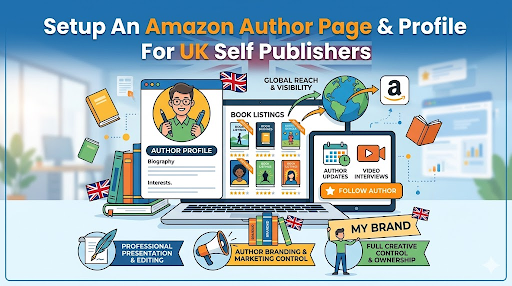
A lot of UK Self Publishers spend weeks fixing their manuscript, making their cover look good, sorting out keywords and dealing with ebook files. Then they leave their Amazon author page looking empty and bare. That is a mistake.
The book listing on Amazon is what sells the book.. The author page is what sells you the person who wrote the book. If your author page is empty, boring or doesn’t exist readers will not have a reason to buy from you. They will be less likely to click on your book.
You need to make an impression on your author page. It is a chance to tell readers about yourself and what you do. Make it look good and make it interesting. This will help you sell books.
Amazon says Author Central lets authors manage their profile across Amazon, Audible, and Kindle, claim books, add biographies in multiple languages, and manage a single presence across several marketplaces, including Amazon.co.uk.
For authors, businesses, and brand-led writers, that matters more than it first appears. A decent Amazon author profile can pull scattered books into one place, make pen names and series easier to follow, and give readers a cleaner path from curiosity to purchase.
For anyone trying to publish a book online in the UK, that is not a cosmetic extra. It is part of discoverability, credibility, and reader retention. Amazon’s own guidance says an Author Page helps readers get to know the writer and find all their books in one place.
Why UK Self Publishers Should Care About This Early
Here is the blunt version. If the author page is missing, unfinished, or poorly handled, the book can still sell, but the wider author brand usually loses out. Readers who enjoy one title often want to check what else the writer has done, whether the author looks active, and whether there is a proper backstory behind the work.
Amazon’s Author Page is built for exactly that. It displays core elements such as bibliographies, biographies, and author profile photos, and it does not come automatically with KDP. Authors have to register for Author Central to get one.
This is especially important in self book publishing UK, where the author often has to do the branding work a traditional house would normally help shape. If the goal is to sell a memoir, a business book, a non-fiction guide, or even a series, the profile needs to look intentional.
The page should answer the quiet questions readers always have. Who wrote this? Are they credible? Have they written anything else? Are they worth following? That is why an author profile should be treated like part of the publishing job, not an afterthought tacked on at the end.
What Amazon Author Central Actually Gives You
Amazon’s current KDP help pages are pretty clear on what Author Central does. Authors can add books to their Author Page, write biographies in different languages, check customer reviews and Amazon Best Sellers Rank, see follower counts, and, in some marketplaces, add photos and videos.
Amazon also notes that photos and videos are a non-US feature, while Editorial Reviews and BookScan data are US-only features. Simply, that means UK-based authors can use the profile quite well, but they should not assume every US tutorial applies feature for feature.
Amazon also says the Follow button on an Author Page or book detail page lets readers follow an author and receive release or pre-order notifications if the book is eligible and the customer allows Amazon marketing emails. That is not a magic growth hack, but it is useful. A stronger author page gives those follows a better chance of happening in the first place.
For UK ebook publishers, consultants, founders, and authors using books as part of a wider commercial plan, this is where the profile stops being a “nice extra” and starts acting like a lightweight brand hub inside Amazon itself.
If a reader lands there and sees a proper bio, a clear photo, linked books, and a coherent identity, trust rises. If they land there and see nothing useful, momentum drops. That is the simple truth of ebook publishing in a crowded marketplace.
What Needs Sorting Before You Set It Up
There is one rule that catches people out. Your book needs to be published before you can create an Author Page. Amazon says that directly in KDP help. So if the manuscript is still being edited, the paperback is not live yet, or the ebook setup is halfway done, the page itself cannot be fully activated yet, though the materials for it can be prepared in advance.
The next thing to get right is name consistency. Amazon says pen names are allowed, and your real name stays anonymous on the site if you use one, but KDP account information should still use your legal name for payment and tax purposes. Amazon also notes that once a book is published, the primary author field cannot simply be edited on that edition.
You would need a new edition to change the primary author name. That is exactly why authors should settle author naming early, especially if they are building a long-term brand.
If budget planning is still fuzzy, it is worth reading The Real Cost to Publish a Book in the UK for New Authors before the launch starts drifting. The author page itself is free to set up, but the wider publishing process still includes editing, production, launch prep, and metadata work that shape how the page performs once readers get there.
How to Set Up the Page Properly
Start Inside KDP
Amazon’s official route is straightforward. In KDP, go to the Marketing page, choose the marketplace where you want to create the Author Page, click Manage author page, and then sign in to Author Central using your KDP account information.
Amazon says Author Central currently supports Amazon.com, Amazon.co.uk, Amazon.de, Amazon.fr, Amazon.co.jp, and Amazon.com.br. That matters for UK Self Publishers because it means the profile can be managed with a wider-market view rather than treating Amazon.co.uk as the only destination.
If the KDP account itself is not yet sorted, Amazon says the account setup requires author or publisher information, payment details, and tax information. It also recommends using the legal name in the account profile and keeping the pen name for book details rather than payment records.
Claim the Right Books
Once inside Author Central, the next job is claiming the correct titles. This sounds obvious, but it gets messy when authors publish under multiple names, use a business imprint, or have separate formats live in different marketplaces. Claim every relevant edition that belongs on the profile.
Amazon’s own help pages tie book eligibility for Author Follow to whether the book has been added to the Author Central account. So this is not admin for admin’s sake. It affects how visible future launches can be.
For authors handling publish a book online in the UK projects across paperback and ebook at the same time, this is also where consistency pays off. Matching author names, linked editions, and a clean bibliography give the page a proper shape instead of leaving it looking cobbled together.
Write a Bio That Sounds Like a Human Being
The biography is where too many author pages fall apart. They either sound like a stiff CV or a vague motivational speech. Neither works. Amazon explicitly allows biographies in different languages, which is useful for authors selling across markets, but the actual copy still needs to sound grounded, specific, and relevant to the reader.
A strong bio for UK Self Publishers should usually do four things. Say who the author is. Explain what kind of books they write. Give one or two proof points that matter. End with a small human detail or positioning line that makes the page feel lived-in rather than machine-written. Business authors should also think commercially. If the book supports consulting, speaking, or a brand, the bio should make that link without sounding like a sales leaflet.
This is also one of the places where a good publishing partner earns their fee. Book Publishers Online positions its service around editing, production, release planning, ebook publishing, distribution, and post-launch support, which matters when an author wants the book, metadata, and profile to feel coherent rather than patched together from five different freelancers.
Add the Bits That Make the Page Feel Alive
Amazon says authors can add photos and videos as a non-US Author Central feature, and can also check follower counts from inside the account. That means UK authors should not leave the page as text-only if they have usable material. A decent author photo, event images, book-related visuals, or short author-facing content can make the page feel current instead of dead on arrival.
Do not overcomplicate this. The goal is not to build a mini documentary. The goal is to make the page look active, credible, and worth following. Even one sharp headshot and a bio that actually says something can do more work than a cluttered page full of waffle.
The Mistakes That Keep Showing Up
The first mistake is waiting too late. Authors often remember the page only after the book is live, reviews are coming in, and the listing is already picking up traffic. By then, they are fixing something that should have been prepared earlier.
The second is inconsistency. Amazon says primary author fields on a published book are not casually editable, and that makes messy naming choices expensive later.
The third is writing a biography with no reader angle. If the page talks only about childhood dreams of writing, but tells readers nothing about the actual books, it wastes the space. And the fourth is treating the page as separate from the wider publishing strategy. It is not. The author page, the book listing, the metadata, the cover, and the launch plan all push in the same direction or they trip over one another.
If you are still comparing service providers before launch, Is UK Book Publishers Legit? What authors should know before they commit is worth reading before signing anything. A sloppy service can leave the files live and the brand side half-built, which is exactly the kind of mess authors end up paying to fix later.
Why This Matters for Authors, Brands, and Businesses
For fiction authors, the page helps readers move from one title to the next. For non-fiction authors, it strengthens authority. For founders, consultants, and businesses, it helps turn a book into a trust asset rather than just another product listing. Amazon itself frames Author Central as a tool for helping readers discover books and get to know the author across multiple surfaces. That means the profile is doing more than sitting there. It is part of the reader’s journey.
That is also why the best time to think about the page is before panic sets in. If the goal is stronger discoverability, cleaner branding, and a better shot at repeat readership, the author page deserves a proper place in the launch process.
No. Amazon says the book needs to be published before you can create the Author Page, although you can prepare the bio, images, and branding decisions in advance.
Yes. Amazon lists Amazon.co.uk among the supported Author Central marketplaces, alongside Amazon.com, Amazon.de, Amazon.fr, Amazon.co.jp, and Amazon.com.br.
Yes. Amazon says pen names or pseudonyms can be used to publish titles, while the legal name should still be used in KDP account information for payments and tax records.
Amazon says authors can add books, biographies in different languages, follower-facing profile elements, and, in non-US marketplaces, photos and videos. Some features such as Editorial Reviews and BookScan are US-only.
Because it supports discoverability, credibility, and author branding in the place readers are already browsing. Amazon’s own guidance says the page helps readers find books easily and learn more about the author in one place.
Where This Starts Paying Off
Setting up an Amazon author page is not difficult. Setting up one that actually helps sell books is where the real work starts. For UK Self Publishers, the winning move is not just getting the page live. It is getting the page aligned with the book, the author name, the metadata, the market, and the bigger publishing plan. Amazon gives the tools. The author still has to use them well.
If the page, bio, ebook setup, and launch materials still feel messy, that usually means the publishing process needs tightening, not more guesswork. Book Publishers Online supports authors with editing, design, digital file preparation, distribution support, and launch planning built around the UK market and wider reach. For authors who want to publish a book online in the UK without leaving the branding side half-done, that kind of joined-up help can save a lot of backtracking later.