
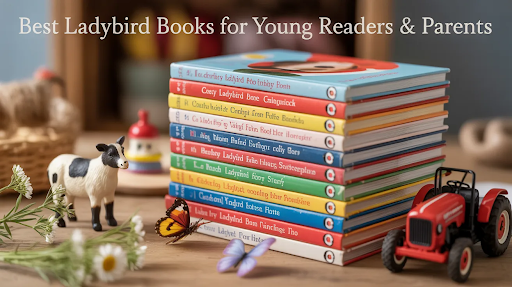
There is something unmistakable about a Ladybird book. The weight of it, that satisfying, pocket-sized hardback, barely bigger than a child’s hand. The smell of the pages. The full-colour illustration sitting opposite every single page of text, as vivid and precise as the day it was printed. If you grew up in the UK, you already know this feeling. And if you didn’t, you’re about to understand why millions of people do.
But Ladybird books are not simply nostalgia. They are the most successful children’s publishing story in British history, a brand that survived two world wars, a dozen educational revolutions, and the digital age, and that in 2026 is still very much alive, still in every major bookshop, and still shaping the way young children in the UK (and across the world) learn to read.
This guide is written for two audiences simultaneously. For parents who are buying Ladybird books for children today and want to know which series actually work, which editions to choose, and how to match the right book to their child’s stage.
And for adults who are rediscovering Ladybird from their own childhoods and perhaps starting to understand, for the first time, quite how extraordinary the publishing formula was.
We will cover everything: from the Key Words Reading Scheme and Peter and Jane, to the Well-Loved Tales, to the Grown-Ups parody phenomenon, to what modern children’s authors can take from Ladybird’s example.
What Are Ladybird Books? A Beginner’s Introduction
The Ladybird Story in Brief — From Loughborough to Penguin Random House
Ladybird began not as a publisher but as a bookshop. In 1867, Henry Wills opened a stationer’s and bookseller in Loughborough, Leicestershire. By 1904, William Hepworth had joined the enterprise, and the business traded as Wills & Hepworth. The first children’s books published under the Ladybird imprint appeared in August 1914, a modest debut that gave no indication of what was to follow.
The closed-wing ladybird logo that most readers recognise today was adopted in the late 1950s, replacing an earlier open-wing design. In 1972, the company became part of the Pearson Group, and in 1998, the Loughborough factory, from which millions of those pocket-sized hardbacks had been produced, closed for good.
Ladybird was fully absorbed into Penguin Books. Today it operates as an imprint of Penguin Random House, the world’s largest publisher. The name, the logo, and the format have outlasted every corporate change.
The Format That Made Ladybird Famous
The most important thing Ladybird ever did was not a particular title or a particular author. It was a decision about format.
The standard Ladybird book, 56 pages, 11.5 cm × 18 cm, hardback was engineered from a printing innovation called the “quad crown” sheet: an entire book printed on a single sheet of paper, folded and cut with essentially zero waste.
This production efficiency allowed Ladybird to retail their books at two shillings and sixpence (roughly 12.5p) for nearly thirty years, a price point that remained stable while almost everything else in British life became more expensive. That commitment to affordability created a generational loyalty that no marketing campaign could have bought.
But the format’s defining feature was not its size or its price. It was the 50/50 rule: text on the left page, full-colour illustration on the right, every single page, without exception. This was not an aesthetic choice. It was a deliberate act of child-centred design, based on the insight that young readers process text and image simultaneously, and that neither should dominate the other.
Before Ladybird, no children’s publisher had thought about the reading experience so systematically from the child’s perspective. It is a principle that holds as true in 2026 as it did in 1940.
The Best Ladybird Books Series — A Complete Parent’s Guide
Key Words with Peter and Jane — Series 641 (Ages 3–8)
No discussion of Ladybird books is complete without Peter and Jane. First published in 1964 and completed in 1967, the Key Words Reading Scheme comprises 36 books across 12 levels, each level split into three parallel sets: a, b, and c, allowing children to revisit the same vocabulary in different contexts before moving on.
The scheme was devised by educationalist William Murray and educational psychologist Joe McNally, and it rests on a rigorous linguistic insight: just 12 words account for 25% of all the English we read and write in everyday life, and 100 words account for fully 50%.
Learn those words, truly, instantly, reliably and reading becomes achievable. The “look and say” whole-word method that Murray built around this research teaches children to recognise words on sight through structured, cumulative repetition. More than 100 million copies have been sold worldwide, and the series remains in print.
Peter, Jane, their dog Pat, and Mummy and Daddy were not invented characters. The models for Peter and Jane were real children living near illustrator Harry Wingfield in Sutton Coldfield.
The books were revised in 1970 and again in the late 1970s to reflect changing social attitudes, Daddy began to take a more active domestic role, and Jane was shown wearing jeans. A short Caribbean-set spin-off series renamed the characters Ken and Joy, extending the scheme’s use in multicultural classrooms.
For parents: if you learned to read with Peter and Jane and want your child to experience the same structured, confidence-building approach, start at level 1a and work sequentially through the scheme.
The look-and-say method is not in competition with phonics, it works alongside it, building sight-word recognition while phonics builds decoding skills. Modern editions, including the 60th anniversary re-releases that began in 2024, are available now from all major UK retailers.
Well-Loved Tales — Series 606D (Ages 4–8)
The Well-Loved Tales series launched with Cinderella in 1964 and grew to 27 titles published over the following decade, concluding in 1974. These are retellings of classic fairy tales, Cinderella, Sleeping Beauty, Hansel and Gretel, The Three Little Pigs, The Gingerbread Man, The Ugly Duckling, written by Vera Southgate in clear, simplified prose that remains faithful to the original stories.
What makes Series 606D exceptional is not just the storytelling but the illustration. Produced by Eric Winter, Robert Lumley, and others, the full-page illustrations opposite Southgate’s economical text represent the Ladybird format at its most beautiful and most enduring. For millions of British children, these were their first encounters with classic literature. The pictures are genuinely fine art, and they hold up as such.
Among collectors, Well-Loved Tales is among the most sought-after Ladybird material, particularly first edition Cinderella in very good condition with the original matt cover. For parents buying to read, modern reprints are widely available and inexpensive.
For parents buying as bedtime read-alouds for children aged three and four, these are among the best choices in the entire Ladybird catalogue: proper narrative structure, clear heroes and villains, satisfying endings, and pictures that a small child will want to stare at long after you’ve finished reading.
On a little side note, we also support children’s book authors through every stage of bringing a manuscript to life: from writing your manuscript to professional editing, cover design, formatting, UK ISBN registration, and distribution.
Read It Yourself — (Ages 3–7, Five Graded Levels)
Now more than 35 years old, the Read It Yourself series was significantly updated in 2024 and 2025 with new content, a clearer five-level structure, and improved curriculum alignment. With over 90 titles across fiction and non-fiction, including beloved brand characters like Peppa Pig and Peter Rabbit alongside traditional fairy tales and original stories, Read It Yourself is the series to choose when a child has completed Key Words and needs a bridge to fully independent reading.
The five-level progression is designed to match exactly where a child is, rather than their age alone:
- Level 1 (Beginner Reader): Ten to fifteen frequently repeated high-frequency words; the illustrations carry most of the story.
- Level 2: Simple sentences, some new vocabulary, parent support still helpful.
- Level 3: Longer text, growing independence, non-fiction topics introduced.
- Level 4: Fluent reader territory, more complex vocabulary, longer narrative arcs, fewer image breaks.
- Level 5 (new addition): Full independent reading, approaching chapter book territory.
Each book includes guidance notes for parents and comprehension questions for children, and the series is aligned to the UK Key Stage 1 curriculum with book band and Lexile measurements clearly indicated. The character-led editions — Peppa Pig, Peter Rabbit, Kung Fu Panda, are particularly useful for reluctant or easily distracted readers: familiar faces dramatically lower resistance to sitting down with a book. For a broader view of what young readers should be exploring alongside this series, our complete UK reading list for 2026 covers excellent titles across every age group.
The Learnabout Series and Early Non-Fiction (Ages 5–10)
The non-fiction range Ladybird built over several decades is, in the view of many collectors and parents, among the most underrated publishing achievements in British children’s books. The broad “Learnabout” and “How It Works” series covered cars, computers, aircraft, and the human body with a clarity and precision that was genuinely radical for its time.
The “What to Look For” nature series (Series 536), four books covering spring, summer, autumn, and winter, illustrated by Charles Tunnicliffe, is widely considered to represent the finest illustration Ladybird ever published. Tunnicliffe’s depictions of British wildlife and countryside are technically precise and visually stunning; these books are as compelling for an adult as they are for a curious ten-year-old.
The “Adventures From History” series (Series 561) offers accessible biographies of historical figures including Napoleon, Wellington, Cleopatra, Florence Nightingale, and Nelson, loved by collectors and still genuinely useful for children aged eight to twelve who are encountering these figures in school.
There is a famous footnote to Ladybird’s non-fiction legacy: in the 1960s, How It Works: The Computer was considered so accurate and clearly written that the Ministry of Defence ordered 200 copies in plain covers for its own staff training. This is what great non-fiction writing looks like. Clarity has no age limit.
Learn with Ladybird and Learn with Peppa (Ages 2–7)
The Learn with Ladybird activity and workbook range is aligned to the UK EYFS and KS1 curriculum, covering phonics, handwriting, maths, letters, numbers, and early emotional development. The Learn with Peppa collaboration extends the range down to children aged two to five, with board books, novelty formats, and phonics titles that use the familiar Peppa Pig characters to introduce pre-reading concepts.
For parents who want structured, curriculum-aligned early learning support at home, this is the practical everyday range, not the series you keep on a shelf, but the one you work through together at the kitchen table before school.
Ladybird for Grown-Ups (2015 Onwards) — The Phenomenon
In November 2015, Ladybird released eight books simultaneously under a new banner: Ladybird Books for Grown-Ups. Written by television comedy writers Jason Hazeley and Joel Morris, the series paired original vintage Ladybird artwork with brilliantly deadpan adult text on subjects including The Hangover, Mindfulness, Dating, The Hipster, The Mid-Life Crisis, The Husband, and The Wife.
At its peak, the series occupied eight of the top ten hardback bestseller slots in the UK simultaneously. Eventually 32 titles were published in total, culminating in The Wonderful World of Ladybird Books for Grown-Ups compendium.
What the Grown-Ups series demonstrated for the publishing industry was significant: when a heritage brand is deployed with genuine wit, respect for the original, and intelligent creative direction, it can reintroduce itself to an entirely new adult audience and simultaneously reinvigorate interest in its children’s backlist. Parents who laughed at How It Works: The Husband went back and bought Peter and Jane for their own children. Brand nostalgia, intelligently deployed, is a serious commercial strategy.
Ladybird Expert Series (2017 Onwards)
The Ladybird Expert series (Series 117) applies the Ladybird format, 50/50 text and illustration, clear and accessible writing, to serious adult non-fiction. Topics include Evolution, Quantum Computing, The Cold War, Climate Change, and Brexit. The series commissioned the first new classic-style Ladybird artwork in 40 years, and the results are as beautiful as anything in the archive.
In 2023, King Charles III co-authored the Climate Change edition, alongside Dr Tony Juniper and Emily Shuckburgh. It remains in print. The Ladybird Expert series is a thoughtful gift for intellectually curious readers who appreciate both design and substance equally.
Vintage vs Modern Ladybird Books — What Parents Need to Know
What’s the Difference Between Vintage and Modern Editions?
Vintage Ladybird (pre-1998) means printed and published from Loughborough in the original format, with original artwork by named illustrators, Harry Wingfield, John Berry, Martin Aitchison, Charles Tunnicliffe. Pre-1970s editions frequently feature matt or dust-jacket covers rather than the laminated finish that became standard from the 1980s onward.
Modern Ladybird (post-1998, Penguin Random House) maintains the same imprint and general approach, professionally produced to current standards. Character representation is more diverse, language has been updated, and the Read It Yourself series was refreshed comprehensively in 2024–2025.
For teaching reading, modern editions are perfectly effective. The pedagogical approach in Key Words and Read It Yourself is the same; the illustrations have been updated, but the method has not been compromised.
For nostalgia and collecting, vintage editions, particularly 1940s through 1970s, with original artwork intact, are the prize. Most are affordable; specific titles in fine condition are genuinely collectible.
How to Date a Vintage Ladybird Book
This question comes up constantly among parents and collectors, and is rarely answered clearly anywhere. Here is the practical guide:
- Series numbers: The first two digits indicate the decade of first publication. Series 401 = first published in the 1940s.
- Price printed inside: “2/6d” (two shillings and sixpence) indicates a pre-1971 edition approximately.
- Cover finish: Matt board indicates pre-1983 approximately; a laminated cover suggests post-1983.
- The ladybird logo: An open-wing ladybird indicates pre-late-1950s. The closed-wing logo was adopted from the late 1950s onwards.
- Tally numbers on rear pages: These appeared from 1963 and ceased around 1974, any book featuring them is from this decade.
- Key symbol on Peter and Jane: A white key in the lower left corner indicates a very early 1960s edition; a black-boxed key appeared slightly later.
Are Vintage Ladybird Books Worth Collecting?
Honestly: most vintage Ladybird books from the 1960s onward are not highly monetarily valuable. Print runs were enormous, and supply remains plentiful. A reading copy in good condition from a charity shop typically costs between £1 and £5.
The exceptions that command meaningful collector prices include: first edition Well-Loved Tales (606D) with intact matt covers, particularly Cinderella in good condition (which sells for £25 and above); very early format books from the 1940s with dust jackets; the “What to Look For” seasonal nature books (Series 536) in fine condition; and any book with verifiable original artwork by Harry Wingfield or Charles Tunnicliffe.
Where to find vintage Ladybird books in the UK: eBay (the largest secondary market, use “completed items” to verify actual prices paid, not asking prices); charity shops, which remain a reliable and genuine source; specialist antiquarian booksellers; book fairs in London and regional cities; and online dealers including World of Books and AbeBooks.
Collector’s truth: buy them because you love them. A small number of specific titles have real monetary value. The rest are there to be read, shared, and enjoyed, which is precisely what Ladybird always intended.
What Ladybird Books Teach Us About Great Children’s Publishing
This is the section written for anyone thinking about writing or publishing a children’s book of their own because Ladybird’s success is not a mystery. It is a case study in what happens when clarity of purpose, respect for the reader, and consistency of execution are maintained for decades.
The 50/50 Text-Illustration Rule — And Why It Works
Ladybird’s strict alternation of text page and full-colour illustration was never accidental. It was based on an understanding, radical in the 1940s — that children process information differently from adults. Crucially, the illustration in a Ladybird book does not repeat the text. It extends it: filling in the visual details the words leave open, allowing the child’s imagination to inhabit the space between language and image. The two pages are inseparable.
This is precisely why the “What to Look For” seasonal books are so beloved: the text tells you what to notice, and Tunnicliffe’s illustrations show you what it looks like when you do. Modern children’s book authors understand this instinctively. Ladybird’s formula is the proof of concept, expressed with a precision and consistency that no individual title has matched.
Controlled Vocabulary as a Craft Discipline, Not a Limitation
William Murray’s Key Words scheme was built on rigorous linguistic research. Writing compellingly within a controlled vocabulary, where every word must justify its presence and clarity is never sacrificed for effect, is a genuine craft discipline, analogous to the constraints of a haiku or a sonnet.
It is harder, not easier, than writing with an unlimited vocabulary. The best Ladybird books demonstrate that clarity and depth are not in opposition. In the finest examples, they are the same thing.
Format Consistency Builds Audience Trust
The pocket-sized Ladybird format never changed. Parents and children recognised it instantly, across decades, in any bookshop. For independent authors building a series, this is a publishing lesson worth absorbing: the visual consistency of covers, dimensions, and presentation is a strategic asset that compounds over time in ways that no single piece of marketing can replicate.
What Modern Children’s Book Authors Can Learn
Four principles emerge from Ladybird’s century of success:
Clarity is craft. Writing simply for children takes more skill than writing complexity for adults. The easiest thing to do is to include everything. The hardest and most valuable, is to know what to leave out.
Illustration is partnership, not decoration. The best picture books and early readers treat the illustrator as an equal creative partner to the writer. The relationship between image and text must be thought through from the very beginning.
Format consistency builds loyalty. If you are building a series, every decision about cover design, typography, and presentation should be made once and then held to rigorously.
Price accessibility creates legacy. Ladybird’s commitment to the 2/6d price point for nearly thirty years created a generational habit of reading that no marketing campaign could have replicated.
If you are thinking about writing a children’s book and want to understand the UK publishing landscape before committing to a direction, our guide on what is the best book publishing service in the UK is the best place to start.
Ladybird Books in 2025 and 2026 — What’s New
Key Words with Peter and Jane — 60th Anniversary
2024 marked the 60th anniversary of the first publication of Key Words with Peter and Jane. Ladybird Education responded with renewed investment in the series: updated learning resources, digital support materials, and re-releases of the original titles.
The methodology has been reinforced by updated reading research, which confirms that the look-and-say whole-word approach works alongside, rather than against, phonics instruction. All major UK bookshops and online retailers carry the current editions.
Read It Yourself — Updated for Modern Classrooms
The 2024–2025 refresh of Read It Yourself is the most significant update to the series in many years. Five levels are now clearly defined, with a new phonics-first Beginner Reader level added at the base. New character collaborations and non-fiction topics have been introduced, and the curriculum alignment to updated UK KS1 requirements has been strengthened throughout.
Ladybird Expert — Still Growing
New titles continue to be added to the Ladybird Expert adult non-fiction range. King Charles III’s Climate Change book, co-authored with Dr Tony Juniper and Emily Shuckburgh and first published in 2023, remains in print and increasingly relevant. The format continues to demonstrate what the Ladybird brand always represented: serious content, beautifully produced, made genuinely accessible.
Ladybird Readers (ELT) — Global Reach
The Ladybird Readers English Language Teaching graded reader series now spans eight CEFR levels, from Pre-A1 through A2+, and is used in international schools across Asia, Europe, and the Middle East. Peter and Jane remains in active classroom use as an English reading instruction tool in parts of Asia. The scale of Ladybird’s global reach, from a bookshop in Loughborough in 1867, is genuinely remarkable.
Frequently Asked Questions
Ladybird Books is an imprint of Penguin Random House, the world’s largest publisher, itself owned by German media group Bertelsmann. The imprint traces its origins to 1867, when Henry Wills opened a bookshop in Loughborough, Leicestershire, and was absorbed fully into Penguin in 1998 following the closure of the Loughborough factory.
Yes. Key Words with Peter and Jane remains in print and is available from most major UK bookshops and online retailers. The 60th anniversary in 2024 brought renewed investment and new resources from Ladybird Education. Vintage reading copies are also widely available secondhand from charity shops and eBay for very little outlay.
For children aged three to five beginning their reading journey, Key Words with Peter and Jane, starting at level 1a, offers the most structured and research-backed approach. Read It Yourself at Beginner Reader level is the modern phonics-aligned alternative. Both are effective; the right choice depends on whether your child responds better to a structured sequential scheme or more varied titles with familiar characters.
No. The Grown-Ups series is a parody written specifically for adults, relying on adult experience, hangovers, corporate meetings, mid-life crises, for its humour. Children would likely find the contrast between the familiar Ladybird artwork and the adult text confusing. As gifts for adults who grew up with Ladybird, they are excellent.
The most sought-after material includes Well-Loved Tales (606D), particularly Cinderella in fine condition with the original matt cover; the “What to Look For” seasonal nature books (Series 536) illustrated by Charles Tunnicliffe; and early format books from the 1940s with intact dust jackets. Most Ladybird books are not highly valuable due to large original print runs, but specific titles in fine condition can command meaningful prices.
Key Words uses the look-and-say whole-word method across a structured 36-book sequential scheme. Read It Yourself uses a mix of phonics and high-frequency words across five graded levels with over 90 titles spanning fiction and non-fiction. Key Words are more rigidly sequential; Read It Yourself offers more variety and flexibility. Both effectively support early reading development.
The Ladybird name and logo are trademarked by Penguin Random House and cannot be used by independent authors. However, the principles that made Ladybird successful, controlled vocabulary, genuine illustration partnership, consistent format, accessibility-first design are entirely available to any writer.
Following the Rose Review in 2006 and subsequent government guidance, UK schools moved predominantly to synthetic phonics, teaching letter-sound correspondence explicitly and systematically. Peter and Jane’s look-and-say method fell outside the recommended approach for school use, though it remains effective for home use and is still used in classrooms internationally. Most UK schools now use phonics programmes such as Oxford Reading Tree. Key Words can still be used alongside a school’s phonics programme; it simply is no longer the method schools are required to follow.
Why Ladybird Books Still Matter in 2026
Whether you are a parent buying Peter and Jane for the first time, a grandparent rediscovering the Well-Loved Tales you once read yourself, or an adult who has just been given a Grown-Ups title as a birthday present, Ladybird books occupy a space that very few publishing brands in any country have ever managed to reach: genuinely loved across generations, trusted without question, and beautiful to hold.
The feeling of picking up one of those pocket-sized hardbacks is not nostalgia for a particular book. It is nostalgia for the experience of reading itself, at the age when reading was still new and wonderful and slightly miraculous.
And if you are a writer who has spent any time thinking about what made Ladybird extraordinary, the consistency of format, the clarity of text, the profound respect for the young reader, you already understand something important about what great children’s publishing looks like. The principles are not complicated. Executing them with the patience and precision that Ladybird managed for over a century is the hard part.
At Book Publishers Online, we support aspiring authors through every stage of the publishing journey including children’s book authors who want to bring those principles to life in the UK market. Whether you need help with writing your manuscript, professional editing, or a complete publishing package from manuscript to distribution, our team is here.
| If you’re inspired & ready to take your manuscript to the next stage, Book Publishers Online can help, from first edit to final distribution. Speak to us today and let’s talk about your book. |