
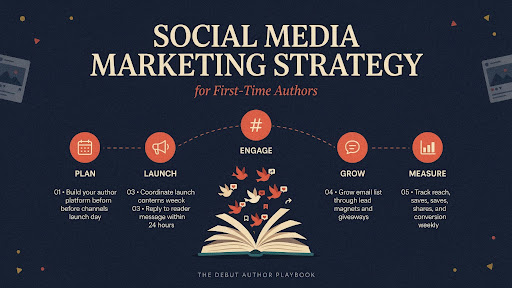
A first book gives you very little marketing history to work with. You have no backlist data, few reader signals, and often no existing audience showing which messages deserve more attention.
That makes a social media marketing strategy useful before launch. The job is to identify likely readers, choose a manageable channel, test several content angles, and record what produces meaningful response.
For first-time UK authors, marketing also sits beside editing, production, retailer setup, and distribution. Professional UK publishing support can help keep those stages connected while the audience work develops.
Start by Defining the Reader
A new writer may spend weeks deciding among TikTok, Instagram, Facebook, LinkedIn and YouTube.
Social media strategy starts with the people who’re most likely to buy, borrow, recommend or review the book. The social media strategy should focus on these people first.
Define the Reader in Useful Terms
Age alone tells you little. So go for genre preferences, comparing authors, recurring interests, favourite content formats and venues where those readers already discuss books.
For a romance novel, that may mean BookTok and Bookstagram communities. A leadership title may fit LinkedIn, YouTube, podcasts, and professional groups across the UK more naturally.
Your first author marketing strategy should answer four things:
- Who is this book for?
- What makes those readers stop scrolling?
- Which two platforms already contain them?
- What action should happen after engagement?
Give the Campaign One Main Goal
Followers, likes, pre-orders, email sign-ups, retailer clicks, reviews, and event registrations measure different outcomes. A focused social media marketing strategy chooses one primary outcome for each campaign phase.
For debut authors, a modest target works well. Build recognisable interest before publication, capture warm readers through email, then direct launch-period attention towards the book page.
Choose Social Platforms by Genre and Reader Behaviour
Platform choice affects workload, content format, and discovery. First-time authors usually need one dependable primary channel, with a second platform supporting content you can adapt efficiently.
TikTok and BookTok for Reader Discovery
TikTok deserves serious consideration for romance, fantasy, YA, thrillers, memoir-led stories, and books with strong emotional hooks. Your social media marketing strategy should still depend on genre fit and reader behaviour.
TikTok reported in April 2026 that 51% of UK readers aged 16–25 discover new books through the platform, while more than 11 million UK book sales in 2025 were attributed to #BookTok. Its 2026 UK BookTok data gives useful context for debut authors targeting younger readers.
Short videos can cover a character dilemma, one striking premise, reader reactions, research behind the story, a location, or the emotional question that pushed you to write.
Instagram and Bookstagram for Visual Identity
Instagram suits authors who can turn their book into repeatable visual material: cover details, carousels, Reels, writing notes, event photographs, early reviews, and reader-generated posts.
Meta puts creation, engagement, reach, and performance guidance in Instagram’s Best Practices creator dashboard. That makes Bookstagram more useful when authors study what people save, share and revisit.
LinkedIn, YouTube and Facebook Have Different Jobs
Non-fiction authors can use LinkedIn for expertise-led posts, case examples, research findings, and speaking topics. YouTube gives room for interviews, explainers, readings, and searchable short-form video.
YouTube recommends a consistent, sustainable creator upload schedule. That principle belongs in a sensible social media marketing strategy, especially when authors are balancing promotion with writing and employment.
Turn One Book Into Several Types of Content
Posting the cover repeatedly gives readers little reason to return. A stronger social media marketing strategy breaks the book into themes, moments, questions, opinions, characters, evidence, places, and reader conversations.
| Content pillar | Fiction example | Non-fiction example |
| Story hook | Character choice with consequences | Problem the book explains |
| Behind the book | Setting, draft note, research trip | Research process or case material |
| Reader proof | ARC reaction or review | Endorsement or practical outcome |
| Author voice | Writing habit or observation | Professional insight or lesson |
| Promotion | Pre-order, launch, event | Release, webinar, media appearance |
Build Recurring Content Series
Recurring formats reduce planning time and help readers recognise your account. They also create comparable data because you can judge similar posts against one another over several weeks.
Useful series include:
- “One thing my character refuses to admit”
- “A real place that shaped this chapter”
- “What I cut from the manuscript”
- “One misconception my non-fiction book tackles”
- “A reader question I keep hearing”
These formats reveal something specific and give readers a reason to return. They can also support a broader book marketing plan while keeping direct purchase messages occasional.
Use a Six-Week Social Media Content Calendar
A simple social media content calendar can rotate discovery, conversation, proof, and promotion. Social media marketing strategy is easier to manage if you prepare content in batches and then later tune it based on real results.
Three useful posts in a week can outperform seven rushed ones when the stronger material generates saves, shares, profile visits, retailer clicks, or new email subscribers.
A Practical Weekly Mix
One post can introduce the book’s world, another can start a reader conversation, and a third can carry proof or a release message. Rotate the order as performance suggests.
A social media marketing book can supply ideas for formats and planning. Your own account data should decide which themes deserve another six weeks of attention.
Build Marketing Around the Book Launch Timeline
First-time authors often start promotion when the retailer page goes live. A healthier social media marketing strategy gives readers several weeks to recognise the book, understand its appeal, and decide whether to follow.
| Timing | Social focus | Useful content |
| 8–12 weeks before launch | Reader discovery | Premise, themes, author introduction |
| 4–6 weeks before launch | Recognition | Cover, ARC reactions, excerpts, context |
| Launch week | Action | Availability, events, reviews, interviews |
| 2–8 weeks after launch | Longevity | Reader posts, FAQs, clips, new angles |
Social activity should sit beside other marketing strategies for book promotion. Email, reviewer outreach, retailer optimisation, events, PR, and Amazon activity can carry attention beyond a single platform.
A broader launch plan helps when deciding how to promote a book across channels. The existing breakdown of practical book promotion activities can support planning around email, reviews, publicity, advertising, and social activity.
Authors releasing digitally also need clean files, metadata, retailer setup and distribution in place before social traffic arrives. Ebook publishing support for UK authors covers that production stage.
Measure Signals That Can Change a Decision
Social media marketing strategy becomes useful when numbers influence what you do next. It requires you to record results. Numbers should be compared across formats enough to spot repeatable patterns.
Track:
- Reach from non-followers
- Saves and shares
- Profile visits
- Link clicks
- Email sign-ups
- Pre-orders or retailer traffic
- Review and ARC interest
- Cost per result for paid campaigns
A post with 900 views and 40 retailer clicks may carry more commercial value than 30,000 passive views. This is where practical social media marketing tips need commercial context.
Mistakes That Waste a First-Time Author’s Limited Time
A good social media marketing strategy protects your writing hours as carefully as your promotional budget. Too many accounts, unclear priorities, and constant posting can drain time you’d rather spend on the next manuscript.
Avoid these habits:
- Opening every platform before proving one works
- Posting only covers, prices, and purchase links
- Copying identical captions across every channel
- Chasing trends that do not fit the book
- Measuring success through follower count alone
- Spending on ads before the retailer page is ready
- Disappearing immediately after launch week
Retailer readiness matters because social traffic can quickly expose weak metadata, cover decisions, descriptions, or categories. Several common Amazon publishing mistakes become especially expensive once paid or organic traffic begins arriving.
The wider work of UK book marketing still includes reviews, email, retail optimisation, advertising, events, publicity, and author positioning. Social media needs a defined role inside that system.
Frequently Asked Questions
What is the most recommended social media platform best for a new author?
There is no leader, no clear winner at least. Fiction often finds chances to shine on TikTok and Instagram while professional non‑fiction works best on LinkedIn and YouTube; audience research should lead your decision.
How much posting on social media should an author do?
Choose a routine that you can maintain for several months. Somewhere between two to four useful weekly posts provide enough material to test themes, formats, hooks, and audience response.
When should first-time authors start marketing their book?
Begin audience-building before publication when possible. Eight to twelve weeks gives you time to test the social media marketing strategy, prepare launch assets, build recognition, and gather early reader interest.
Can I market my book without showing my face?
Yes. Voiceovers, book photography, annotated pages, hands-only videos, screen recordings, illustrations, setting footage, quote graphics, and reader reactions all support social media for authors who prefer privacy.
Does social media actually sell books?
It can drive discovery and influence purchases when content reaches the right readers. Track retailer clicks, email sign-ups, pre-orders, sales movement, and reviews alongside likes and comments.
How should I market my book after launch?
Keep using successful themes, add reader reactions, answer new questions, repurpose interviews, and connect posts with broader book launch marketing. Knowing how to market your book after release protects momentum.
Build Reader Recognition Before Chasing Reach
As a first-timer, the social media marketing strategy for an author like you is one you can explain in a sentence: who you want to reach, where they spend time, and what you want them to do.
Book Publishers Online supports UK authors with audience research, campaign planning, content direction, Amazon visibility, and post-launch promotion. A clear plan gives your first title a stronger route from manuscript to market.
Give your debut book a campaign built around its genre, audience, launch stage, and realistic budget. Start a First-Time Author Marketing Plan Built for UK Readers!